THE STRANGELY UNPAINTABLE EAST HILL
Right next to Hastings, a town full of artists, is the East Hill, designated as Hastings County Park. It’s an area of woods, valleys, sea cliffs, a hill that served as an iron age (or thereabouts, could be bronze age or pointy stick age, a long time ago anyway) fort, ponies brought in from Exmoor to eat the not very appetising grass, Highland and Galloway cattle likewise, sheep, a pond or two, a quarry, carpets of bluebells in the springtime, even visiting peregrine falcons. In theory the artists should be crawling all over it, blending all these ingredients into a glorious visual soup but in practice there’s something strangely defeating about the place. I’ve been walking around there for years, not quite able to believe how none of it resolves into anything paintable. Sometimes I take paint, thinking it can’t possibly be as uninspiring as I remember it. I bring it back unused.
People use the Old Town and the pier and the sea and the shore as subjects all the time, and the flow of paintings of the picturesquely decaying fishing fleet coming out of Hastings is virtually incontinent. But the East Hill remains unpaintable. Holman Hunt managed it once (Our English Coasts/Straying Sheep) by arranging a load of sheep on a cliff edge as an allegory for something or other, but Victorians were pretty unstoppable once they thought God wanted them to do something. Turner managed a dramatized version of the East Hill from out at sea, painting the cliffs as golden yellow rather than as the 1970’s orangey-brown they actually are. Sometimes an enterprising dauber will sit on the East Hill and look at something else, such as the view towards Rye and Dungeness (nothing says English landscape like a nuclear power station on the horizon). All I can manage is something like this:
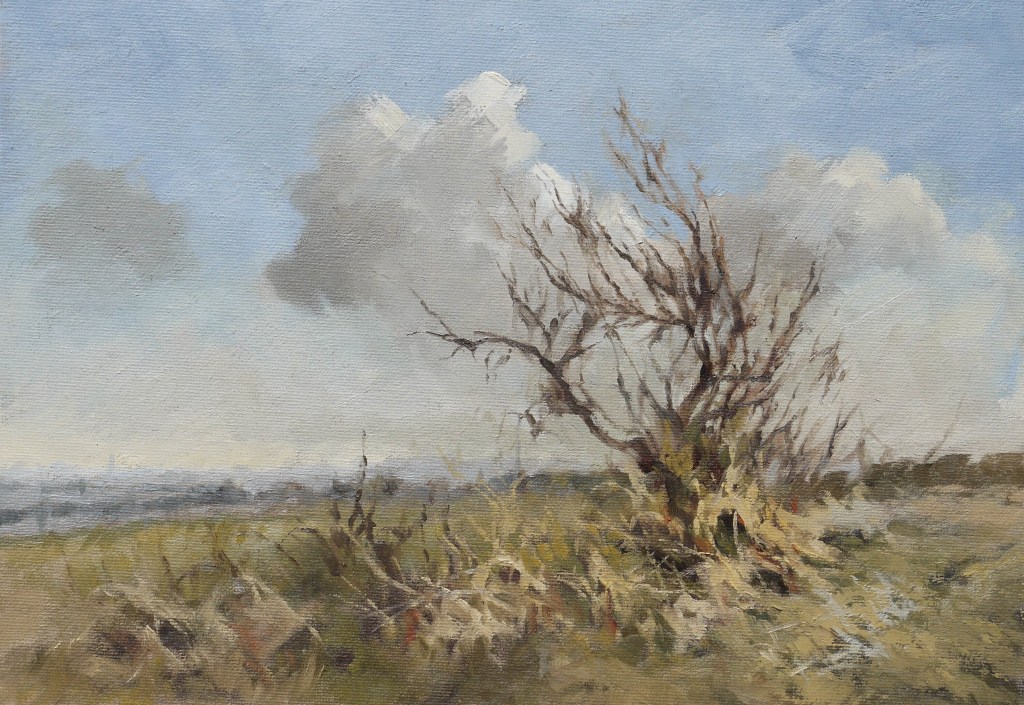
It’s just, I dunno, scrubby, lifeless. As I was attempting a painting on the East Hill once a shirtless man drinking from a can of Stella walked up to a tree and punched it. Presumably a performance artist, failing like the rest of us to produce a work of any merit.
You can do much better with plankton. Wait for enough of the little wrigglers to die and leave their skeletal remains on the seabed, shove the resulting layer into the air using tectonic forces, hang around while the weather erodes it all, and ta-dah, the rolling hills of the South Downs.


That’s more like it, although you’ll notice that the results look nothing like what was in front of me. And that I should have taken some lemon yellow to get some less ochre-y greens, but it was the end of summer and I wasn’t expecting beginning of summer colours. You’ll also notice that there’s really nowhere to take a leak so apologies to anyone in the village of Wilmington who was looking through binoculars at the time but, you know, if you are that nosey you kind of deserved it.
 RICHARD SWANN ART