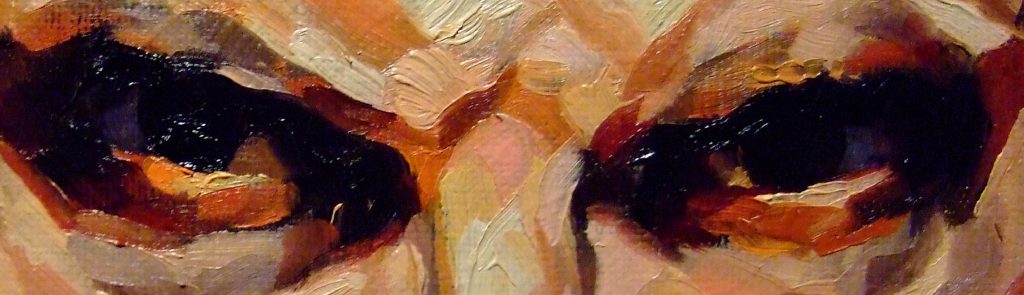
IT’S SUNLIGHT. OBVIOUSLY.
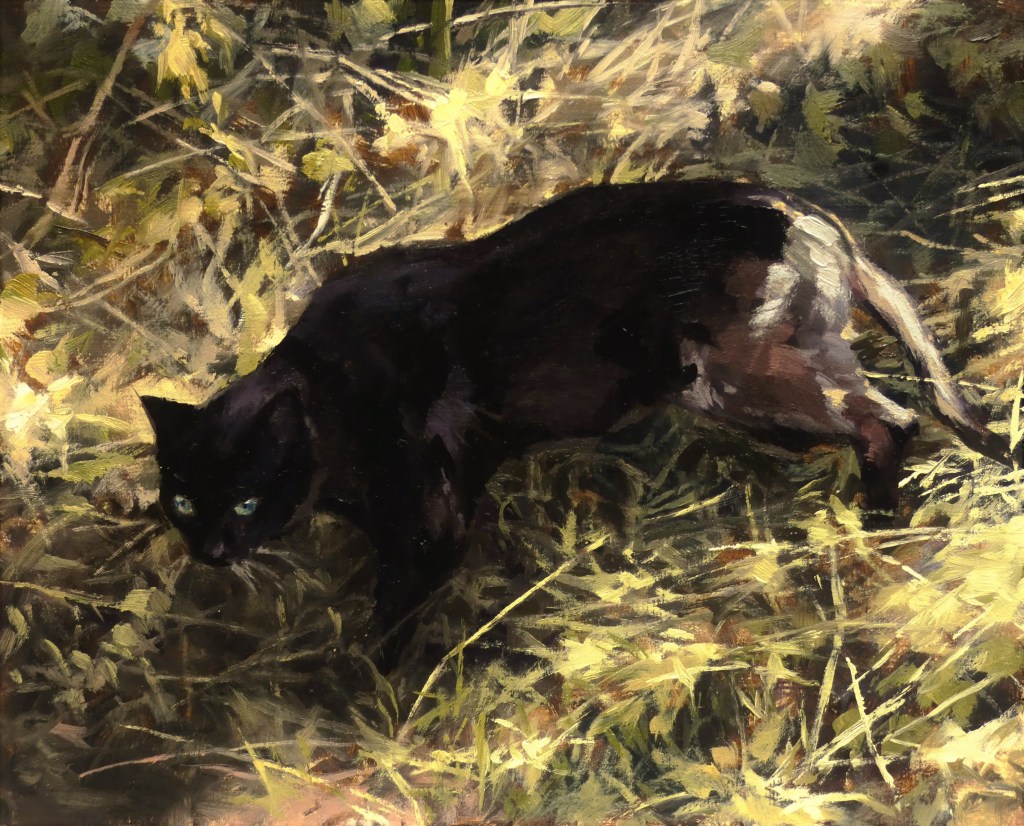
Black Cat
When your paintings are for sale in the place where you work, you get a lot of unfiltered feedback. Who would guess that the guy failing to frame a football shirt at the back of the shop, slumped in defeat before the cursed contrariness of fabric, asking the gods why a signed George Best shirt has to be XL when George Best was an S, maybe an M at most, is also responsible for the paintings of scruffy birds and disreputable beasts and rusty scissors on the walls? Obvious when you look at his hair and clothing but by now the customer has loudly voiced an opinion:
– That’s a rabbit not a hare (printer’s error, not mine).
– The rabbit and the grass are done in different styles (guilty as charged your honour).
– Mountains aren’t that colour (listen, a Scottish cousin of mine recently described an entire hillside of ‘acidic orange’).
– That beak’s the wrong shape (true, it’s far too pointy).
– That’s hideous (yeah, and it’s a self portrait, so thanks).
And so on. Recently there’s been a consistent theme. The cat must have sat in some whitewash. There must be some cat-bothering deviant roaming the streets of Hastings armed with flour bombs. It’s a piebald cat but the pie’s all up one end and the bald’s at the other.
It was actually a black cat. All over. Stalking something in bright summer sunshine and about as inconspicuous as a goth on a beach, until either by coincidence or with impressive guile it chose to sneak along the shadow cast by a tree. In the painting most of it is in the shadow but its rear end is still in the sun, on its way to joining the front of the cat in crepuscular obscurity but not quite there yet. And just you get hold of a cat, bound to be one lying around somewhere, and shine a bright light on it. The hairs reflect. Sort of. When seen from the right angle. So, in short, no way have I painted the cat wrong.
Hope that settles matters.
I may repaint the cat.
THE UNPAINTABLE EAST HILL AGAIN
One of the few things making the East Hill almost worth the schlep are the Exmoor ponies cropping the grass on the slopes by the radar station. If you reduce the scenery of the Hastings County Park to a few marks hinting at two paths crossing, a bit of fence, and one of those sideways bushes you get on unsheltered hills by the sea, it forms an adequate background to something more interesting.

(If you’re seeing a horse with a very thin neck look again, there’s another bit of mane there that’s blending into the tree behind which is unfortunate but at one stage it looked like someone had drawn a line round it with a marker pen and at another stage it was actually purple so it could be worse).
There for environmental reasons rather than decoration, they like the scrubby grass fighting its way up through the unpromising soil and apparently it’s good for every one if it gets nibbled. But sadly they’re going. Maybe it’s a bit restricted for them, there’s not really anywhere to gallop unless you want to go over a cliff or headbutt the radar station or mash yourself into a fence. We’re left with some Belted Galloway cattle, rotund, minimalist pianos, a flat a tone and a sharp, so hopefully they’ll step up to the mark and start arranging themselves more artistically instead of lying on the floor digesting stuff which is all they seem to do at the moment.
YEAR OF THE RABBIT
A rabbit. From a photo taken on the East Hill, a short walk from where I live. Obviously couldn’t be bothered to go to Sumatra and photograph a tiger. Done with Williamsburg oils which come all the way from New York State, so at least someone made an effort. They’re a bit drier and less oily than other paints, at least the earth colours I’m using are, which is a boon to someone who struggles to control a slick painting surface. It has to be said, they could be less expensive. There’s a lot of room for that, a big, wide range of smaller prices that they could put on themselves, the sort of friendly, unintimidating prices you’d find on a tube of Winton. But I suppose with hand-painted swatches and titles like Italian Black Roman Earth you can’t really quibble.
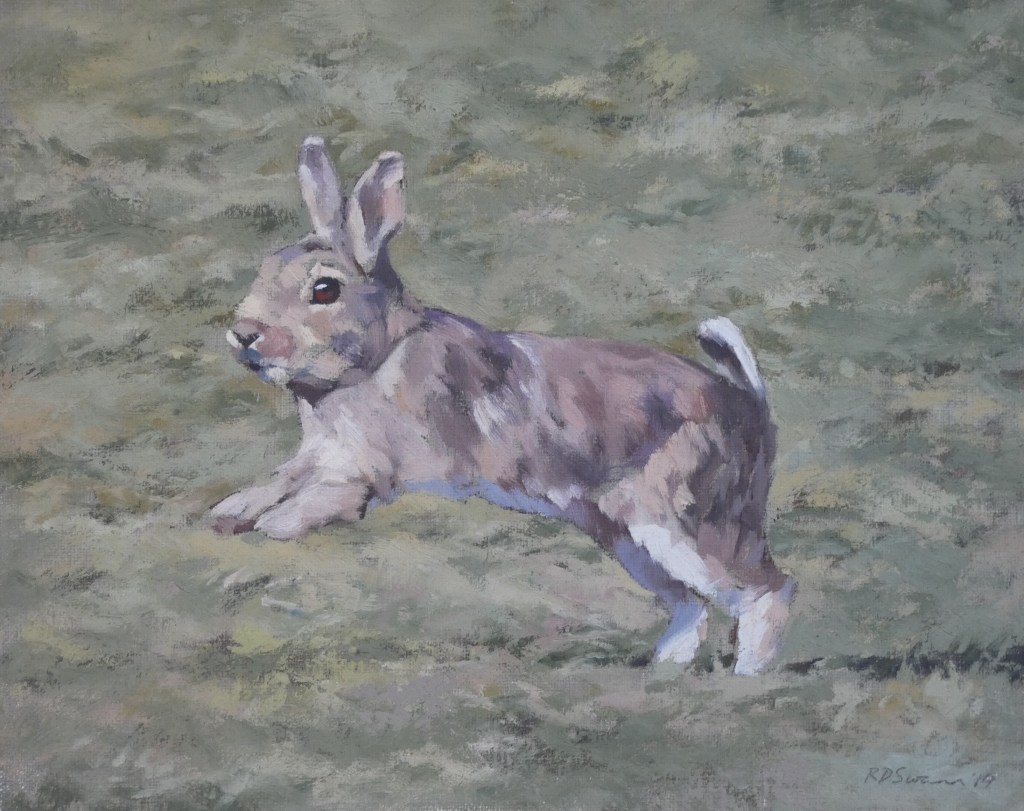
East Hill Rabbit #2
REVERENCE
As if being killed by a cat and dragged into someone’s house isn’t enough, you then get put in a sandwich box littered with crumbs and residues of cheese and peanut butter and chucked in a fridge. In the ice-making bit at the top with a warped plastic door that someone melted with a fan heater when they were defrosting it one time. Not even a proper freezer. Then you’re taken out and put on a piece of board balanced on a computer while someone does a painting of you and watches a Grand Prix on the screen behind you. All very amateurish, the guy’s not even working in a proper studio, the light’s bad and he’s mixing his paint on a plate. You’ve only got about half of this unprofessional no-hoper’s attention anyway and to add insult to injury it’s another tedious Mercedes one-two.
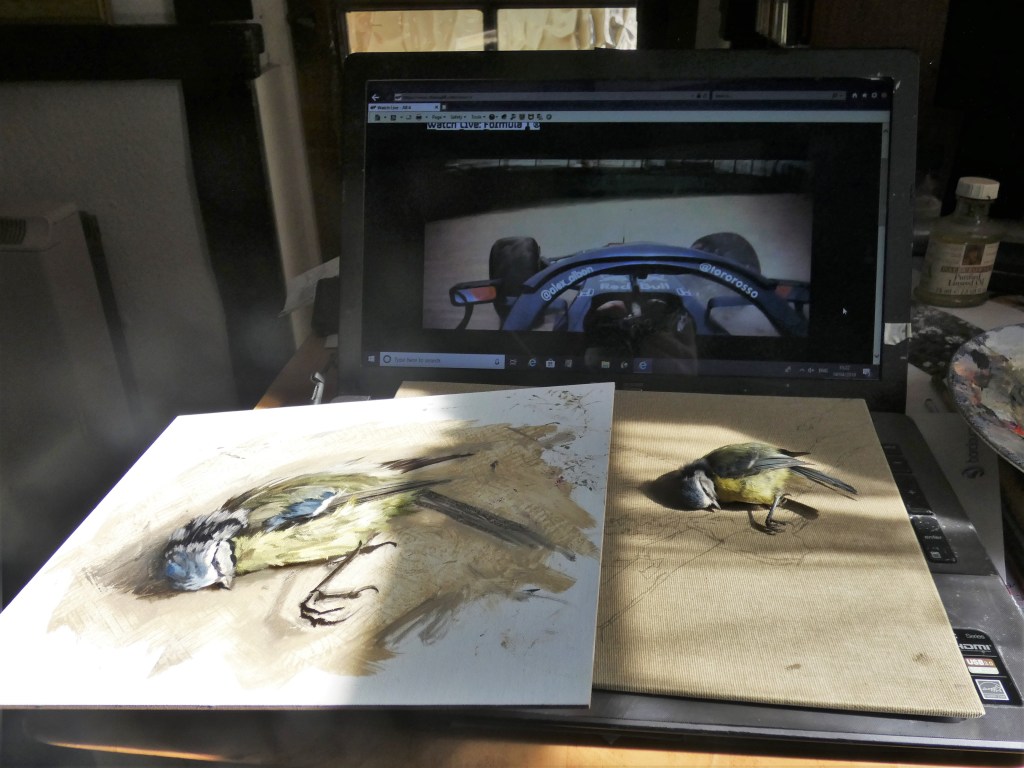
But consider this, little ptichka. Consider your immensity. Walk into a cathedral and you are struck by space, immense, echoing space, and by light, streams of it, miraculously coloured. Step back outside again and there’s even more space out there, and even more light, but you didn’t notice it. The cathedral is designed to reveal, and to awe with the revelation. A dead bird has the same effect. Sudden knowledge of the detail and complexity of the world, of how precious and fragile life is. The only way to respond is with awed appreciation, with reverence. One purpose of humans, maybe the only purpose, is to be conscious of stuff, it’s our unique ability, there’s no point in all those supernovae and sunsets and waterfalls existing without someone to appreciate them. And for a while, despite the sandwich box, the freezer and the Grand Prix, you occupied and dazzled my consciousness of the world.
A painter is trying to pull off the same effect as the thousands of tons of stone and glass of the cathedral, only on a small rectangle of canvas using pigments suspended in binder. It’s a noble but futile ambition, and not something I could ever do as well as an ex blue tit.
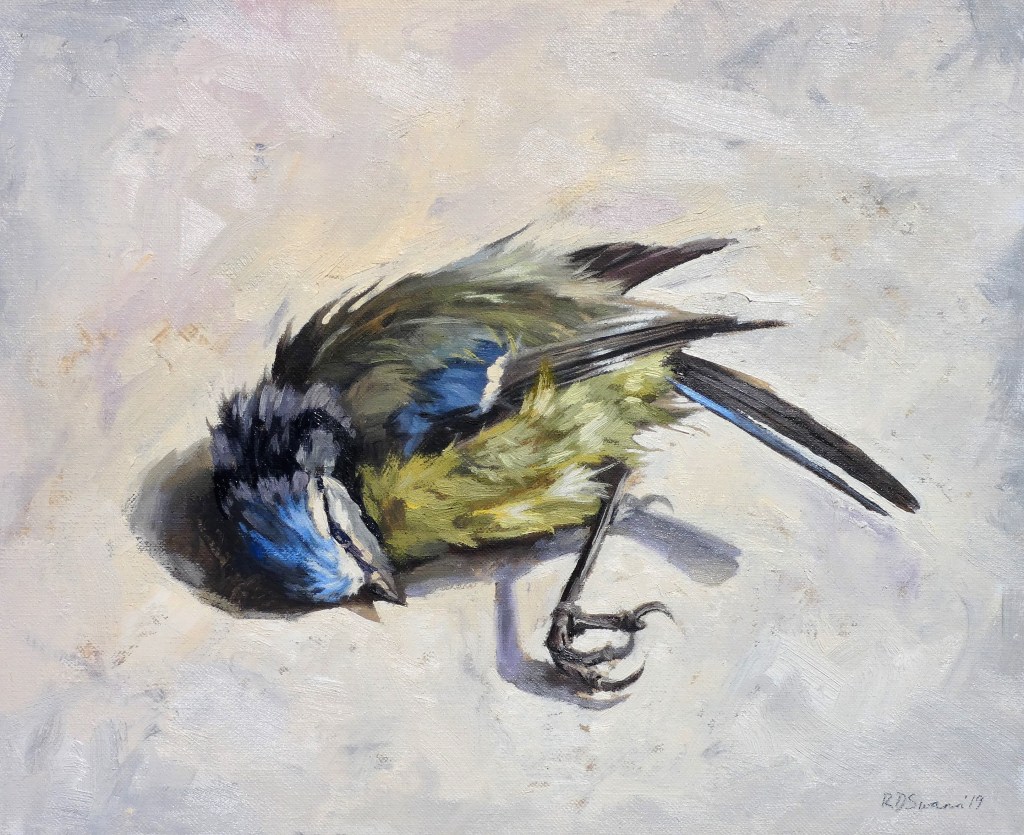
Blue tit
CLOUD WITH A FACE
A friend of mine saw a kingfisher in Alexandra Park recently. I went for a walk across a muddy field and saw some sheep. So sheep it is.
Photo 1 has a nicely positioned sheep. It’s looking at us, and it looks like a sheep. Photo 2 has a better lit sheep and it’s standing on the horizon, looking, by sheep standards, quite dramatic. A heroic sheep about to set out on a noble quest. But it’s turned slightly away and painting the back end of a sheep is a depressing task. So the plan is to take sheep 1 and angle it up a bit like sheep 2, then light it similarly and position it against the sky.


Taking a piece of 18 X 24cm canvas board (actually I’m poshing up and using linen on board, but the term linen board doesn’t exist, if you asked an assistant in an art shop for some they’d punch you in the face, and you can’t say linen canvas board either, it’s a total contradiction, essentially a first world problem and if we all pull together we can get through this) step one is to sketch out an adjusted sheep. I like to use a mix of burnt sienna and black diluted with thinners, applied with an old, worn down brush which gives a sketchy, scrubby line, characteristics which I fondly hope will persist into the finished painting.
Second stage is putting some colours down to see what they look like, using a minimal palette of white, black, burnt sienna and yellow ochre. We are after all talking about a sheep here, in December, not a beach ball in July. The idea is the black has a lot of blue in it and mixed with white will look blue relative to the rest of the painting, and mixed into the ochre it will give subdued and controllable greens. The decision to position the sheep against a cloud might well result in a picture of a cloud with a face (beginner’s mistake).


Stage three, no getting away from it, is to slap loads of paint on. This is where everything goes wrong, probably best to draw a veil over the whole grim process but suffice to say, large, confident-looking brushstrokes will make it look like you know what you’re doing, even if you have to go back in with a smaller and more controllable brush and a palette knife to make the stroke the shape you intended.
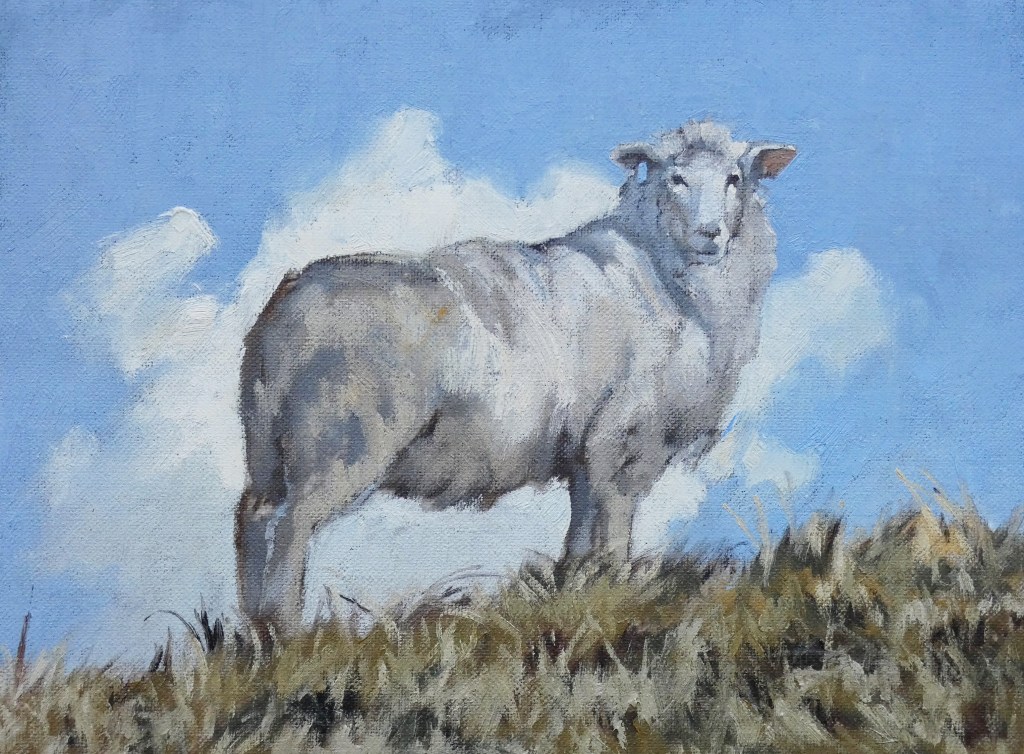
Boxing Day Sheep
Ok in the end I mixed a bit of blue into the sky along with the black. The thing in her ear is meant to be one of those tags, I made it the same colour as the sky which would be a nice touch if you could see it. The actual tag was more of a plastic clip, even less visible, so what with the repositioning, relighting, bum-losing and cloud-adding there’s a lot of artistic licence going on. Maybe I could title it Sky Coloured Ear Tag to subtly draw attention to it but for now it’s called Boxing Day Sheep. Should really be The Day After Boxing Day Sheep. More artistic licence.
CALL THE CHIROPODIST


Feet. You have to have them, they’re the only thing between you and the pavement and you know what that looked like last night, even if the blood has since washed away and the half-digested kebab has been eaten by a fox . But they’re always awkward to draw, courtesy of the parsimony of paper manufacturers, who never made sheets of paper long enough to get the model’s feet in when you were doing life classes, leaving you tragically short of foot drawing practice. Birds are no exception. Consider the crow above. I had a reasonable stab at rendering the foot in all its clawed and reptilian ugliness but putting the other one in as well resulted in a confused knot that didn’t look like bird feet. So it ended up with just the one foot. The sparrows in the middle were fobbed off with some vague foot-like marks. The poor creature on the right is going to have to get through life with no feet at all, like a London pigeon.
SO THAT’S WHERE ALL THE BRUSHES WENT…


Thought I was losing brushes. Turns out I’ve been scattering them over the Sussex countryside all summer. Unless your prize Hereford has just choked on a paintbrush and the insurance doesn’t cover it, in which case I haven’t.
Everyone’s a Critic


Consider exhibit A. Observe the scratch down the middle, inscribed by a rooster which walked along a row of paintings lined up at the end of a day’s plein-airing with the BDAG at a farm, stopping at mine and delivering a mighty headbutt to express its disapproval.
Consider exhibit B. Another Ruskin of the bird world has delivered its verdict upon my oeuvre. I was sat under a willow tree at the time (exhibit C), not the easiest thing to perch on so it must have taken considerable trouble to pass comment.
Exhibit D is the defiantly finished sketch. You may now unleash your inner critic by observing that it looked better with the avian addition and I should have left it.
LAST MEN SITTING
First plein air day of the summer with the Battle and District Arts Group and it’s a day of rain at Mountfield. Starting as a few drops on the canvas (Daler Board chopped to fit a pochade) then getting heavier and interfering with the paint. Oil paint repels rain but the water sits in place in drops and eventually, such is the decisive speed of your brushstrokes, you’re aquaplaning. How on earth does Roos Schuring manage? (Quick bit of internet research – having stabilised the easel with a bag of sand she tapes an umbrella, a white wedding umbrella, to it to keep the rain off the painting surface). Being made of less stern stuff me and my Dad opted for sitting under a tree. Then under a bigger and denser tree when the rain got heavier. To be fair we were the last men standing, if only metaphorically. The results are all a bit grey and get progressively broad (as in broad brush strokes and less detailed) but this is no bad thing – having to make a painting from decidedly uncolourful scenery in the rain is the sort of out of the comfort zone thing that plein-airing is supposed to provide. The things in the field in the first painting are sheep, in case you were wondering, and the third one is two trees and a column of smoke from a gypsum works, as any fool can tell.


ADMIRAL ON BOARD
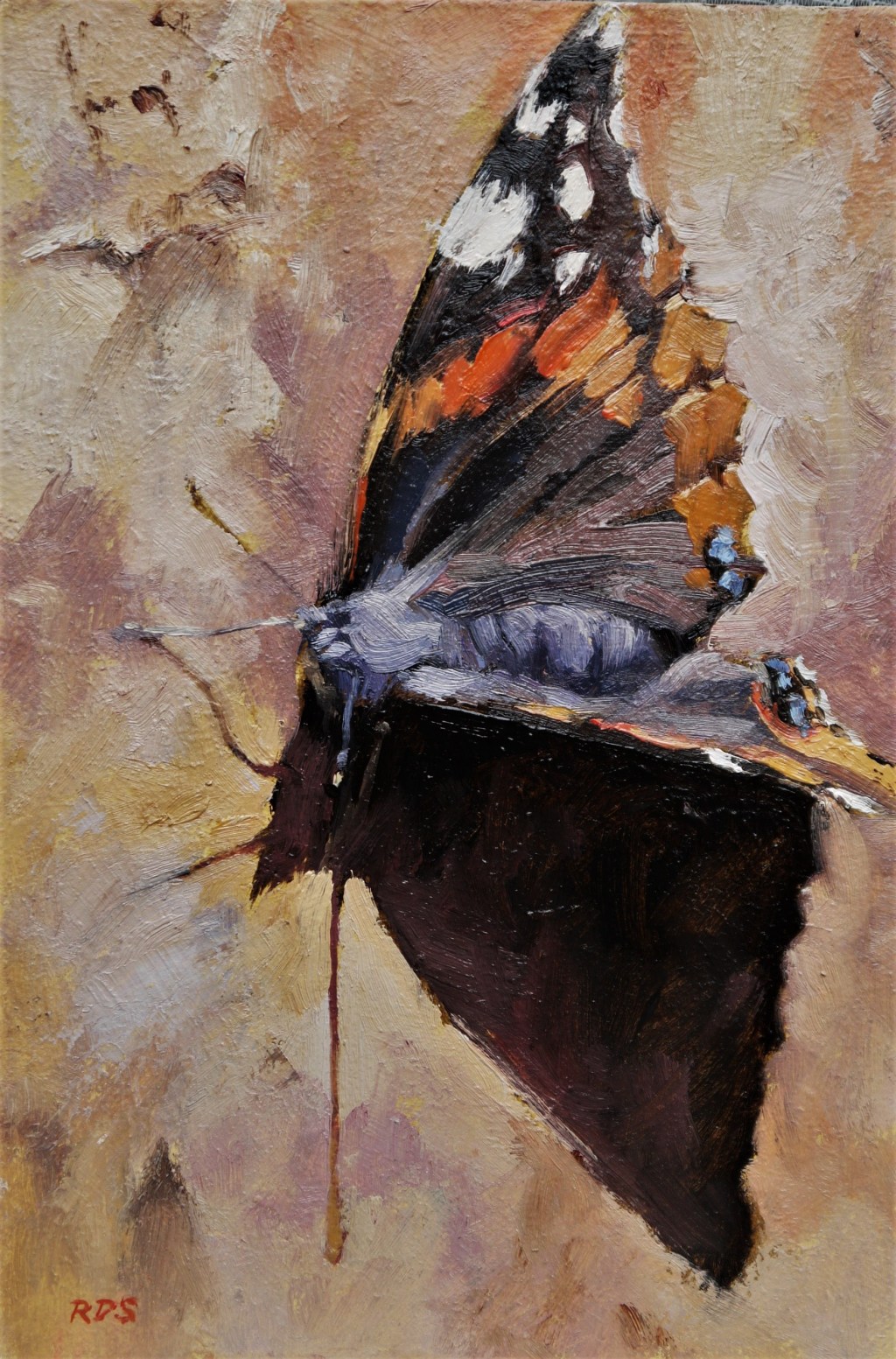
Admiral On Board
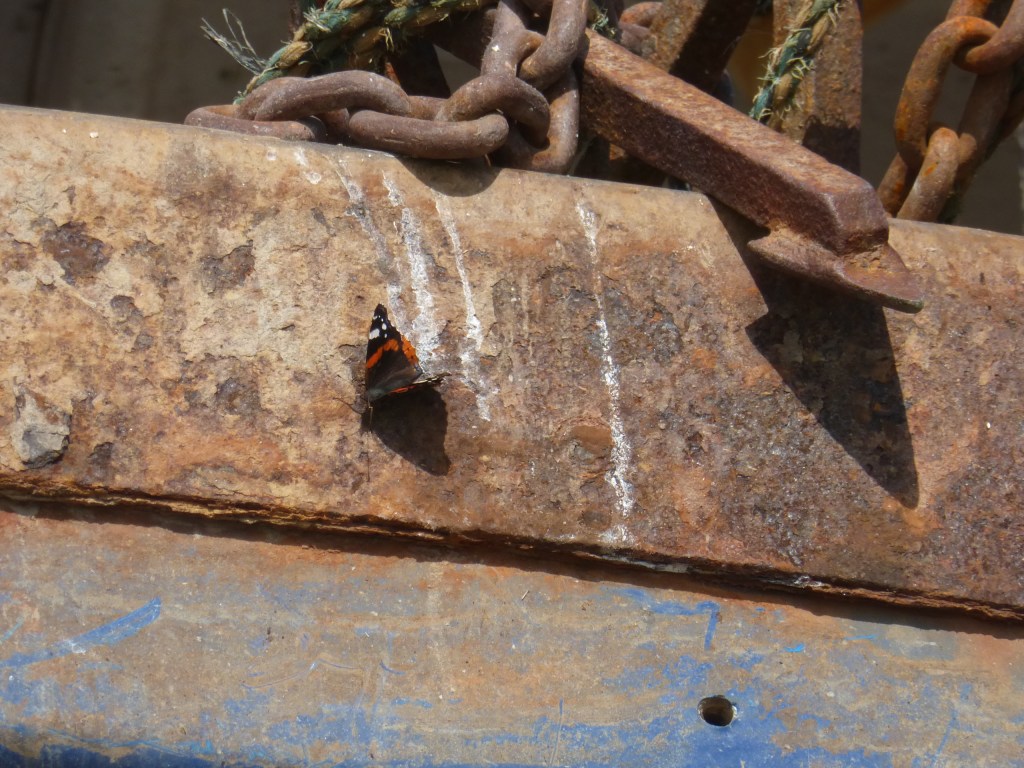
Red Admiral, sunning itself on one of the fishing boats (see below – nice when nature is this cooperative), and painted on a piece of board, so on board in two senses.
 RICHARD SWANN ART