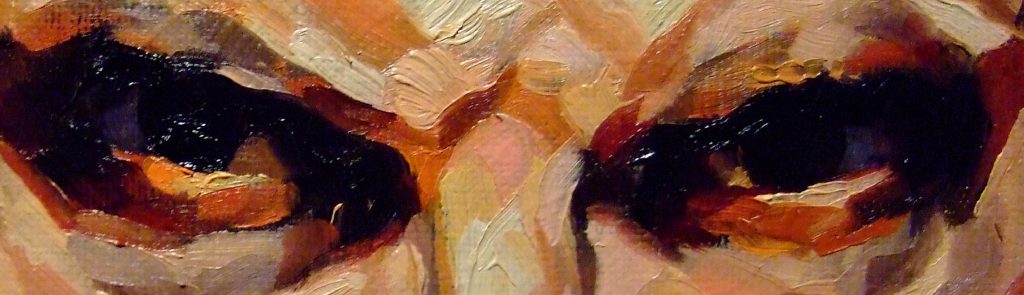
FURTHER ADVENTURES OF SATAN’S SNOT
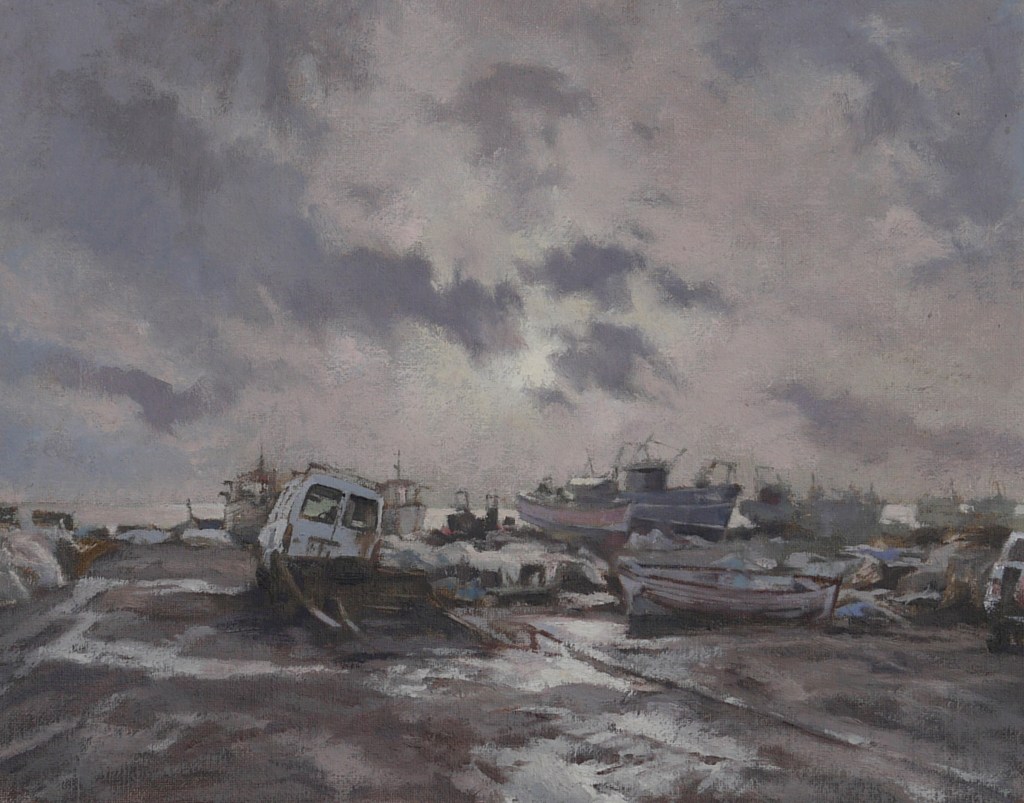
After Rain
Hmm. The dryness of the flake white replacement makes a change from the usual slick and skiddy surface, a bit more manageable when painting skies even if they do look a bit laboured. As usual the fishing beach was stacked with odd-shaped things under tarpaulins, if you can’t tell what anything is meant to be neither could I.
PACKAGING SATAN’S SNOT


It’s not as if Jackson’s (bless their large range and affordability) can claim that this was the smallest box they had available for posting a 37ml tube of paint. They gave themselves away by putting the paint in a smaller, perfectly postable box inside the bigger one, cushioned lovingly in plastic air-filled pillows. Why they stopped there and didn’t put an even larger box around the whole thing is a mystery. But perhaps this is misjudging the packers. I worked in a packing factory, and like to think that all those upside down labels and unsealed envelopes and burned magazines (that machine was a joke) were a cry for help, a yell of defiance from people forced to listen to Heart FM all day. Maybe this cardboard behemoth is actually a piece of conceptual art, a devastating critique of the consumer society, a rebuke to me for not patronising my local art shop.
Reason I didn’t patronise the local art shop is because this was a very specific tube of paint, Gamblin Flake White Replacement, made in the USA. Your actual flake white is of course poisonous, and like syphilis and consumption has gone out of fashion. But it was used for centuries (probably, too lazy to check) and you have to wonder whether we’re missing anything (other than deafness, insanity and all the other symptoms of lead poisoning), and this stuff is supposed to have similar characteristics but in a non-toxic form. Did a quick sketch to try it out (see above) and the first hurdle was getting it out of the tube. What eventually emerged was a reluctant half inch of SATAN’S SNOT which is not what it says on the label. It’s the right colour but the consistency is unlike anything I’ve used before, like painting with mozzarella cheese, stringy and resistant. There was an immediate reaching for the palette knife as being the only thing on hand equal to handling the rubbery resin, followed by the discovery that it’s very sculptable stuff. In fact very usable if you like a congealed and textured paint surface, so I’m not giving up on it just yet.
Hope springs eternal that one day the right painting surface, the right paint, the right brush, will happen along and magically hand the ability to paint to us. It’s a delusion that underpins a lot of the art materials market – within you lurks a painting god, just waiting to be liberated by the invention of the battery-powered ceramic painting stick. Still, got me a new toy to play with. If I can persuade any more out of the tube…
Aaah, cute…
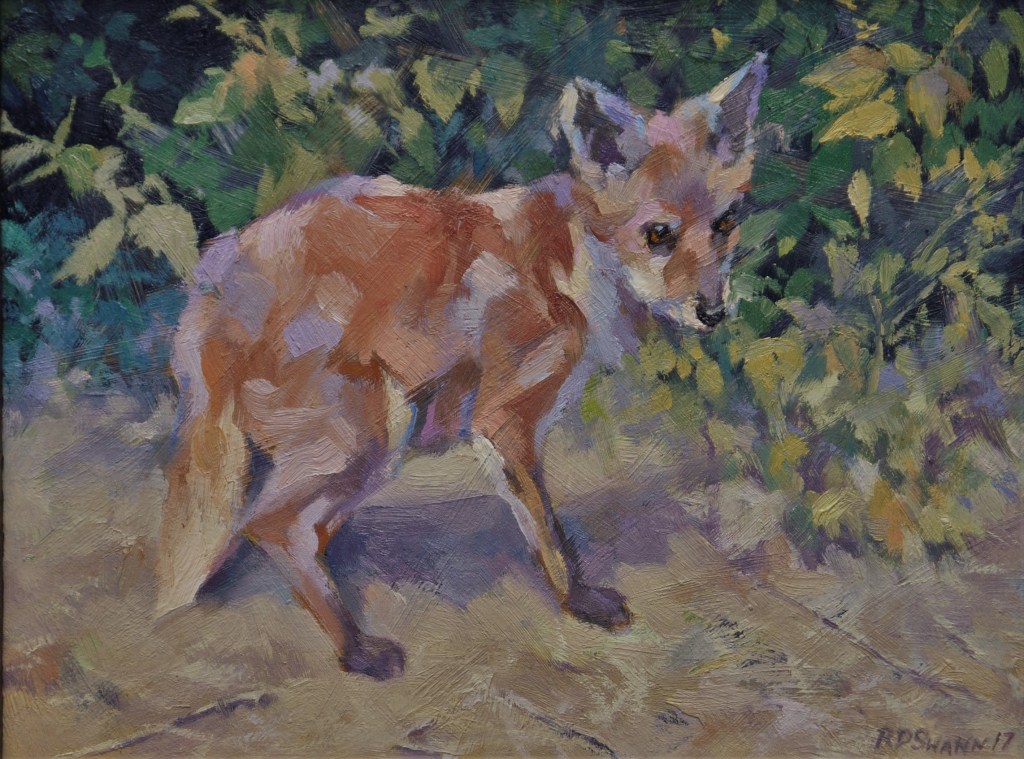
Foxcub
Done from a photo taken last spring so it’s probably grown up and ripping open bin bags by now.
THE STRANGELY UNPAINTABLE EAST HILL
Right next to Hastings, a town full of artists, is the East Hill, designated as Hastings County Park. It’s an area of woods, valleys, sea cliffs, a hill that served as an iron age (or thereabouts, could be bronze age or pointy stick age, a long time ago anyway) fort, ponies brought in from Exmoor to eat the not very appetising grass, Highland and Galloway cattle likewise, sheep, a pond or two, a quarry, carpets of bluebells in the springtime, even visiting peregrine falcons. In theory the artists should be crawling all over it, blending all these ingredients into a glorious visual soup but in practice there’s something strangely defeating about the place. I’ve been walking around there for years, not quite able to believe how none of it resolves into anything paintable. Sometimes I take paint, thinking it can’t possibly be as uninspiring as I remember it. I bring it back unused.
People use the Old Town and the pier and the sea and the shore as subjects all the time, and the flow of paintings of the picturesquely decaying fishing fleet coming out of Hastings is virtually incontinent. But the East Hill remains unpaintable. Holman Hunt managed it once (Our English Coasts/Straying Sheep) by arranging a load of sheep on a cliff edge as an allegory for something or other, but Victorians were pretty unstoppable once they thought God wanted them to do something. Turner managed a dramatized version of the East Hill from out at sea, painting the cliffs as golden yellow rather than as the 1970’s orangey-brown they actually are. Sometimes an enterprising dauber will sit on the East Hill and look at something else, such as the view towards Rye and Dungeness (nothing says English landscape like a nuclear power station on the horizon). All I can manage is something like this:
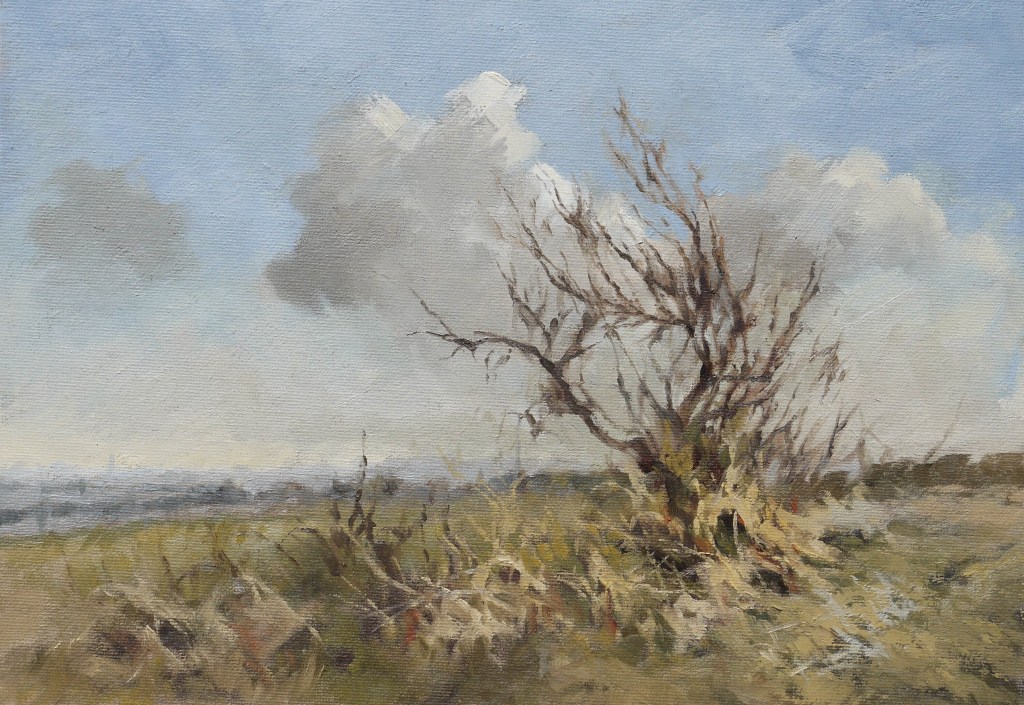
It’s just, I dunno, scrubby, lifeless. As I was attempting a painting on the East Hill once a shirtless man drinking from a can of Stella walked up to a tree and punched it. Presumably a performance artist, failing like the rest of us to produce a work of any merit.
You can do much better with plankton. Wait for enough of the little wrigglers to die and leave their skeletal remains on the seabed, shove the resulting layer into the air using tectonic forces, hang around while the weather erodes it all, and ta-dah, the rolling hills of the South Downs.


That’s more like it, although you’ll notice that the results look nothing like what was in front of me. And that I should have taken some lemon yellow to get some less ochre-y greens, but it was the end of summer and I wasn’t expecting beginning of summer colours. You’ll also notice that there’s really nowhere to take a leak so apologies to anyone in the village of Wilmington who was looking through binoculars at the time but, you know, if you are that nosey you kind of deserved it.
PLEIN AIR AND PRODUCTIVITY
Ah, the great outdoors. There’s loads of it – hills, rivers, fields, trees, all sorts of stuff, and it doesn’t need paying.
Sure, the light changes every five minutes, you’ve got about an hour before it starts raining and this field probably belongs to an angry psychopath but think how that’s going to stop you dithering. No agonising about colour choices and the meaning of art and spending hours deciding which view to select. Frankly with a load of painting gear to lug about, right here will do. And there you are, a finished daub in one hit. Which is more than you’ve managed in the past week.
A good idea is to hit the great outdoors mob-handed, if there’s a whole bunch of you out there, you are, by the authority of numbers, normal. Making anyone else wandering around a cagoule-wearing freak who has done nothing to earn their sandwiches except stare slack-jawed at some cows. And take some pensioners with you, they’ll find the only spot for miles with a view, out of the wind, somewhere to sit and within shuffling distance of a toilet. I usually finish two 16cm X 20cm panels in a five hour excursion, not much more than note-taking but it feels like being a proper artist.


Better with, or without?


A question opticians ask as they put lenses in front of your eyes. Usually there’s no difference. Having added tendrils to the onion above to create a more hirsute vegetable I found them a bit annoying, too busy and a different colour to the rest of the picture, so took them off again. Hours of brow-furrowing and chin-stroking and holding-at-arm’s-length-and-squinting went into that decision. Likewise the painting below:


Better with enigmatic blue bit at the top or without? This could take a while.
A LACK OF EAGLES
“Is eagle?”
“No. Not eagle.”
By the time it was close enough to be identified as a buzzard the bloke from some place where they have eagles had gone his way, off to build vital infrastructure judging from his attire, and I’d gone mine, off to frame pictures. In its own nearest-thing-we’ve-got-to-an-eagle way the buzzard circling over the Sussex countryside was magnificent, but a long way off, and as usual a dark silhouette. All in all there’s a general lack of eagle-level wildlife presenting itself, close up and beautifully sunlit, outside the artist’s window.
There are always gulls of course, as close as anyone could wish . But to be honest anyone happy to take a dump off a roof in front of an audience somehow lacks the allure of the elusive (so if you were thinking of trying it to improve your social standing and appeal to the opposite sex you might want to think again).
If life gives you lemons, they say, make lemonade. So here, using what presents itself everyday outside the window, is a sparrow soufflé.


POLLY
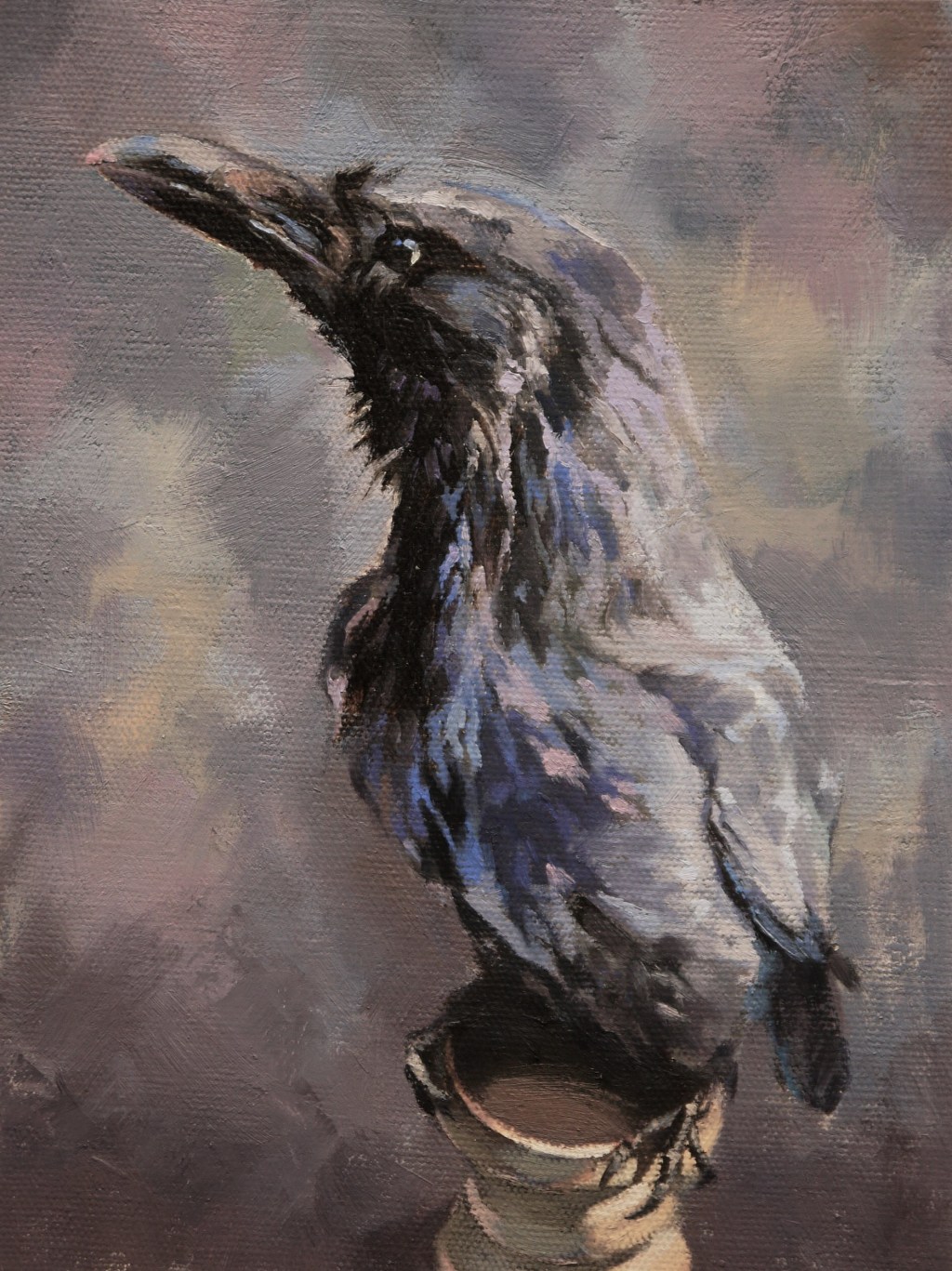
Polly
Badly named crow or badly painted parrot? Who can say. Named after Polly Harvey so at least the poor animal claws back some dignity.
HOW TO FILL SPACE (WITHOUT RESORTING TO FRAMING YOUR LIFE DRAWINGS)

Penknife. And flower, obviously.
Exhibition coming up. Anything you have to lift a page on a calendar to see is too far in the future to be a worry, so sod it, play another level on Candy Crush Saga. You’ll have done a hundred paintings by then, having in the meantime made that elusive style breakthrough that enables the effortless production of deathless masterpieces by the ton.
And then it’s almost here and your meagre output is not going to fill even the single screen you’ve hired. Time to get creative – frame some sketches, some photos even, call some of your reject paintings ‘studies’, pin up an Artist’s Statement, that’ll fill an A4 space. In fact if you’d been this creative to start with in the painting department the problem wouldn’t have arisen. And the resource you have most of, that chalky stack of scribblings that’s built up into a tower of ruined paper… Resist! Remember at all times NO ONE WANTS TO SEE YOUR LIFE DRAWINGS. They have their own stack of shame that’s built up over the years. In the town where you live there are at least a million life drawings. None of yours look even remotely human anyway and to be honest we all know what happens to bodies over time and don’t need the evidence rubbed in our faces.
However, at the backs of cupboards, hidden under the bed beneath serious layers of dust, lurk warped canvas boards, battered pieces of gessoed MDF, stretched canvases with rusting staples, upon which is written the history of your failure. It’s important not to throw these away (the people who chuck your trash onto a lorry might see them for a start, have some consideration) because there was nothing wrong with what you were trying to do. You failed in the attempt, it was doomed from the first, hesitant, uncommitted brushstroke with that colour you instantly knew was wrong and should have scraped off and mixed again. But you ploughed on, reluctant to write off any of your precious time and effort. With the passage of time however comes an indifference to the amount of work you put in, and you can now overpaint the thing with the right colours and the bravura that were needed in the first place, happily obliterating hours of toil and most importantly creating some much needed space filler in very little time.
The above is an example.
Yeah I know, but you should have seen it before.
IS THIS A VIEW?
-
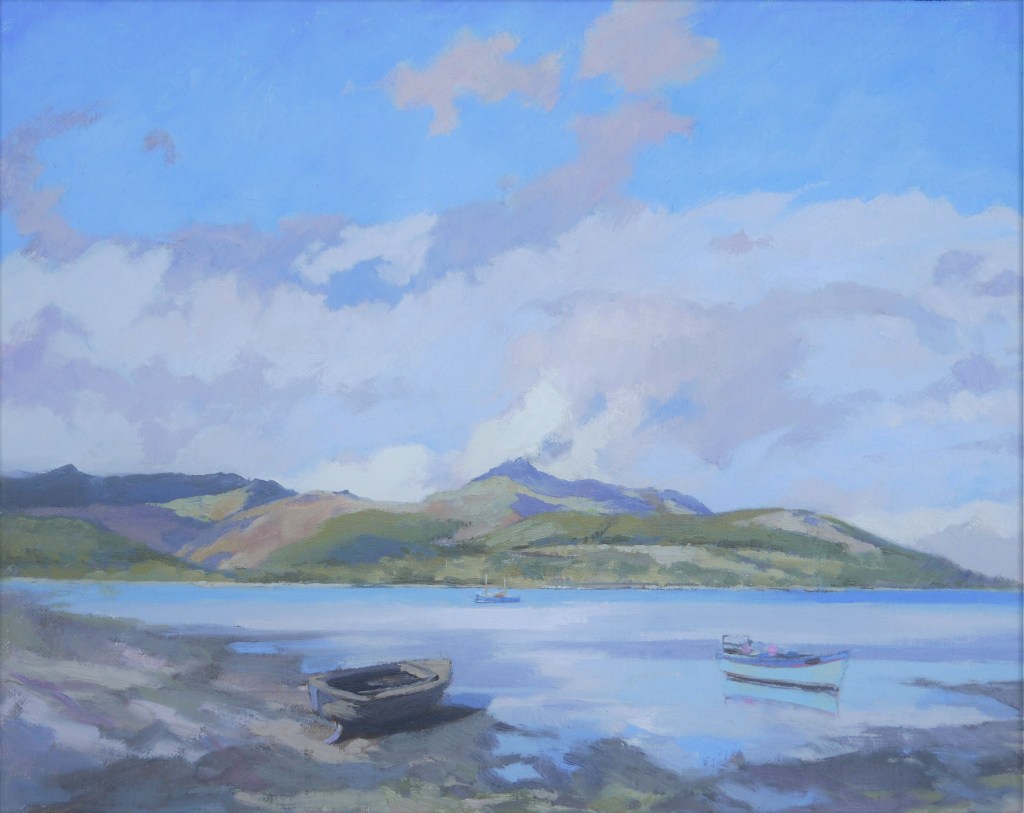
Across The Bay From Brodick
Technically anything is a view. You could be waiting for an elevator in a building in New York, the hideous, tasteless gold doors could open to reveal the spectacle of Nigel Farage trying to insert his head into Donald Trump’s flabby fundament like a Nazi cork in a scrofulous, acned blubber-bottle and you would be correct in your use of the English language if you turned to a companion and remarked, ‘That’s not a view I was expecting’. But in art it usually implies a vista, a distant prospect, sweeping distances to elevate the soul, deathlessly composed into pleasing and balanced harmony.
I don’t really do views. There are good reasons and bad reasons for this. Good ones include the way a view can tend towards the prettified, the conventional, and demand so much technical accuracy getting everything the right size and shape the whole thing turns into a gruelling slog, with the feelings that inspired you to start long forgotten. Concentrating on a smaller area can be more spontaneous and imply a whole landscape in the way a short story can imply a whole life. (You can smugly quote William Blake to yourself at this point, a world in a grain of sand and all that, you know you want to). Bad ones include laziness, a lack of painting stamina, not being dedicated enough to lug anything larger than a small pochade around, and not having enough time or space to work large-scale.
The above image is fairly viewish however. It sort of demanded it. Done from photographs, wisely ignoring the disastrous watercolour I did on the spot.
 RICHARD SWANN ART